
What Happens to Your Body Composition on GLP-1?
What Happens to Your Body Composition on GLP-1? The bathroom scales show signs of progress. Your body shape is changing. Friends and family are noticing. But what is actually happening inside your body? Are you losing belly fat, or is it something else? Let's find out...

Firstly, what is GLP-1 medication?
GLP-1 (glucagon-like peptide-1) medications are a class of weight loss drugs, including semaglutide and tirzepatide, used to treat Type 2 diabetes and obesity. GLP-1 medications work by mimicking the GLP-1 hormone to lower blood sugar, slow digestion, and increase feelings of fullness. Most are administered as weekly self-injectable pens, with well-known brand names including Ozempic, Wegovy, and Mounjaro. Beyond weight management, they also support cardiovascular health when looking at heart disease, making them one of the most significant developments in weight loss medicine in recent years.
Secondly, what is body composition?
Body Composition refers to the different types of tissue your body is made of, primarily fat mass and lean mass (muscle, bone, organs, and water). Your total body weight is the sum of all of these. We've written about this in more depth in our previous post on why body composition matters, but here's the key point:
Two people can weigh the same and have the same Body Mass Index (BMI), but have completely different body compositions. One might carry a higher proportion of body fat, particularly abdominal fat and central obesity, while the other carries more muscle. Clinically, these offer us two very different pictures of health. When you're on a GLP-1 medication, knowing which picture is changing matters far more than the number on the scale.
Thirdly, what does GLP-1 actually do to fat?
The news here is genuinely encouraging. A 2026 systematic review of 36 studies found that GLP-1 medications significantly reduce both total body weight and fat mass, with one type of fat being especially responsive: visceral fat.
Visceral fat is the deep abdominal fat that sits around your organs. You cannot see it or pinch it, but it is the fat most strongly linked to serious health conditions, including heart disease, Type 2 diabetes, and metabolic syndrome. Reducing visceral fat is a real health win for you, not just a cosmetic one. The fact that GLP-1 medications appear to target it effectively is clinically significant.
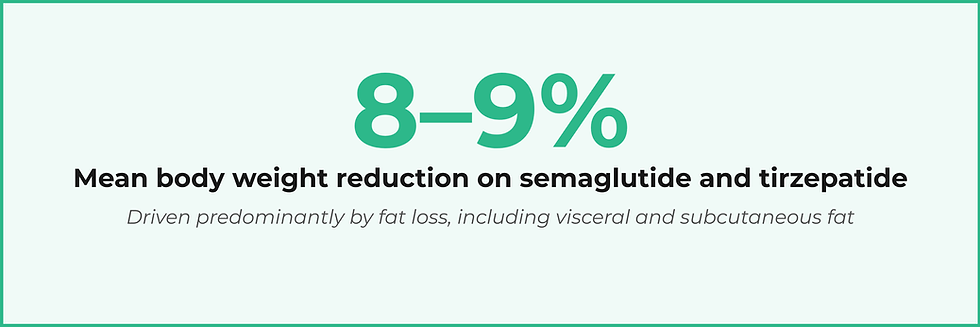
Studies show that people taking semaglutide and tirzepatide achieved mean body weight reductions of around 9% at three months, driven largely by fat loss, including reductions in visceral fat, subcutaneous fat, body fat percentage, and overall fat distribution. Longer-term studies show continued progress beyond that. For anyone concerned about cardiometabolic risk, these are meaningful changes that a bathroom scale alone will never reveal.
Fourthly, what happens to muscle?
This is a part that deserves some attention, because most people on GLP-1 medications either worry about it too much or have never been told about it at all.
Across multiple clinical trials, roughly 20–40% of the weight lost by GLP-1 medications comes from lean mass rather than fat. In one meta-analysis of 22 randomised controlled trials, patients lost around 0.86 kg of lean mass for every 2.95 kg of fat, meaning roughly one quarter of their total weight loss came from lean tissue.
That might a bit sound alarming, but there is important context here. Some lean mass loss during a weight loss programme is expected regardless of how you lose the weight. This is not unique to GLP-1 medications. What matters most is the ratio: are you losing predominantly body fat, or is too much muscle being lost alongside it? The bathroom scale will never tell you this.
One study followed 106 patients on semaglutide over 12 months. Lean mass did initially dip in the first several months, but it stabilised after that and crucially, grip strength actually improved over the course of the study, up 4.5 kg by 12 months. Broader research confirms that GLP-1-induced weight loss largely consists of fat, with only modest lean mass decline, provided people take protective steps, as is outlined below.

So, what are the protective steps?
The research here is consistent. Three things make a meaningful difference.
Resistance training is the single most protective intervention. People who combined structured resistance exercise with GLP-1 usage saw lean mass losses as low as 3–7%, compared to 26–40% in those who did not exercise. Aim for 3–5 sessions per week. That is a substantial difference, and it puts a lot of the outcome directly in your hands.
Protein intake matters just as much. Taking around 1.2–1.6 g of protein per kilogram of body weight each day. Combined with resistance training, it is the most protective combination available for preserving muscle during your weight loss journey.
Tracking your progress is the third step, and it is where most people fall short. The number on the bathroom scale cannot tell you whether you are losing body fat, muscle, or a mix of both. It cannot show you whether your visceral fat is reducing. For that, you need to look at body composition, not just body weight.

Why is the bathroom scale not enough?
If your weight drops by 5 kg, you cannot tell from that number alone how much was body fat and how much was muscle.
A 2026 JAMA Network Open study of over 3,000 patients confirmed that both semaglutide and tirzepatide were associated with substantial fat mass loss and an improved fat-to-lean ratio over 24 months, though bariatric surgery produced even more favourable changes.
The bathroom scale flattens all of that into one number. For people putting genuine effort into their weight loss journey, that number is simply not enough information.

How can you track what is actually changing?
The gold standard for body composition is DEXA scanning (dual-energy X-ray absorptiometry), which gives an accurate breakdown of fat mass, lean mass, and bone density. The limitation is that it requires a clinic visit and is not practical for regular monitoring.
Smart scales that estimate body fat percentage using bio-electrical impedance are convenient but imprecise. They are affected by hydration, time of day, and body position, and tend to be less reliable for people with higher body fat.
As an alternative to DEXA, waist circumference is a simple, underrated measure. If your waist measurement is shrinking, that typically signals visceral fat loss, even when the scale appears to stall. Hip circumference and waist-to-hip ratio also offer useful signals about how your body shape is changing.
The Body Volume Index (BVI) takes a different approach. Using 3D body scanning and computer learning from just two smartphone photos, BVI calculates not just how much you weigh, but where you carry it, specifically, how weight is distributed around your abdomen relative to the rest of your body.
Because abdominal fat distribution is the most clinically significant factor in cardiometabolic risk, that ratio tells you whether your body is actually changing in the ways that matter, even when the scale is moving slowly.
It is a more meaningful alternative to BMI for anyone on a weight loss journey.
The mybvi app lets you track this at home, over time. As your GLP-1 works, you can see whether your body shape and composition are shifting in the right direction, not just whether the number on the scale is going down. Validation by Mayo Clinic compared the Body Volume Index technology to DEXA and the results were very favourable.
So, What Actually Happens to Your Body Composition on GLP-1?
GLP-1 medications are really impressive. They drive significant fat loss, especially visceral and abdominal fat, with real benefits for cardiometabolic risk and long-term health. The muscle question is real, but it is manageable, particularly with resistance training, adequate protein, and the right kind of tracking.
The most important shift is moving from tracking body weight to tracking body composition. The scale tells you something has changed. Body composition data tells you what changed and whether it is moving in the right direction.
You are already doing the hard part. The missing piece, for most people, is simply being able to see what is actually happening inside.


Comments